The Rolex Yacht-Master II is big, bold, and packed with serious sailing tech. Most owners aren’t racers, but they love the look, the engineering, and the statement it makes. If you want something subtle, skip it. If you want presence, this one delivers.
Know About It!
If you hang around and watch people long enough, one piece always comes up. The Rolex Yacht-Master II. And right after that, the same questions follow. I hear them every single week. Some are from first-time buyers. Some are from hardcore collectors. Most of them circle back to the same idea: what makes a Rolex yacht watch so special?
Here’s the thing. This watch isn’t subtle. It’s big. It’s loud. It’s technical. And people either love it or don’t get it at all. There’s rarely a middle ground. So instead of answering these questions one by one in real life, I figured I’d lay them out here.
If you’ve ever stared at the Yacht-Master II and thought, “Do I really need this?” or “Is this even practical?” you’re in the right place. Let’s talk honestly about the watch everyone keeps asking me about.
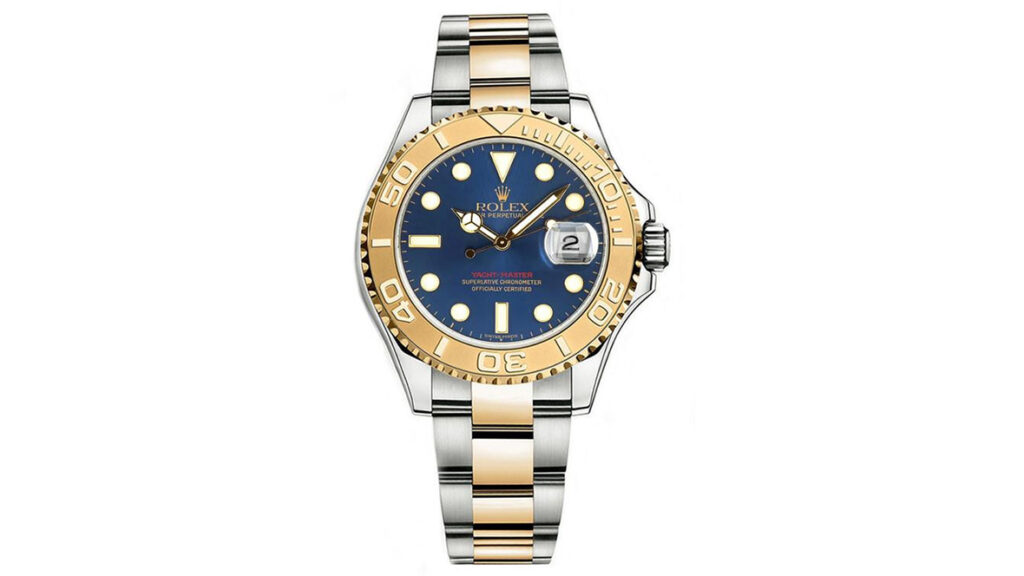
#1 Why Is the Rolex Yacht Watch So Big? (44mm Case)
The Yacht-Master II is massive. At 44mm, it’s one of the largest modern Rolex models. This watch is significantly bigger that the classic 41mm Submariner or 40mm GMT-Master II.
While some collectors worry about the “super case” bulk, Rolex designed this footprint for a specific reason: legibility. During a high-stakes regatta, a sailor needs to read the countdown scale at a glance in spray and sun. The Oystersteel case features massive, polished lugs and a thick profile that gives it more “wrist presence” than almost any other professional watch in the catalog. If you’re used to the slim profile of a Datejust, the Yacht-Master II will feel like a substantial upgrade in both weight and scale.
#2 What Does the “Ring Command Bezel” Actually Do?
That bezel isn’t just for show. It’s one of the smartest parts of the watch.
The blue ceramic bezel isn’t just a timer—it’s a Ring Command Bezel, a patented mechanical component linked directly to the watch’s internal movement. Unlike a standard diver’s bezel that just rotates, this one acts as the “key” to the Calibre 4161 movement.
By rotating the bezel 90 degrees, you “unlock” the ability to program the mechanical memory countdown (from 1 to 10 minutes). This allows professional sailors to sync their watch with the official race start sequence. Even if you never step foot on a boat, the engineering required to link a exterior bezel to a column-wheel chronograph inside is a feat of horology that justifies its premium status.
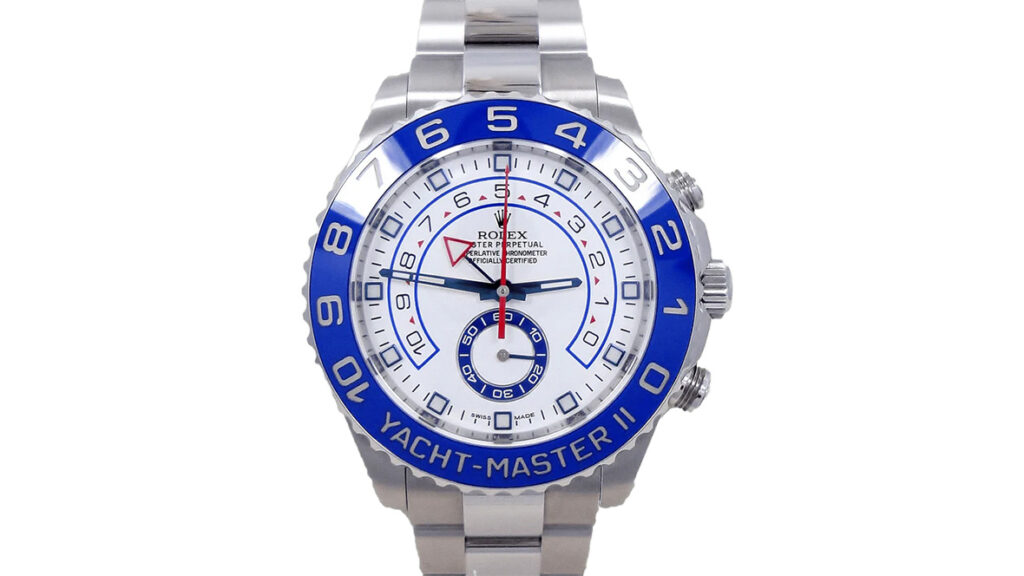
#3 Is It Only for Sailors? (Regatta vs. Tool Watch)
Short answer: no. Long answer: also no, but people love pretending it is.
Technically, this is a Regatta Chronograph, but its appeal has shifted toward luxury “statement” collectors. While it features the Triplock triple waterproofness system and is water-resistant to 100 meters (330 feet), it is rarely used as a tool for diving.
That said, it’s still a proper tool watch. It’s water-resistant to 100 meters. It’s built like a tank. You can swim with it. You can travel with it. You can wear it daily if you want.
It’s has become the “bold alternative” to the Submariner because it’s available in premium materials like the 18ct Everose Rolesor and solid 18ct yellow gold.
#4 Why Is the Yacht-Master II Price So High?
This question never gets old. People look at the price and blink twice.
First, the movement. The Yacht-Master II uses one of Rolex’s most complex calibers.The Calibre 4161 took over 35,000 hours to develop with 360 individual components. That programmable countdown isn’t cheap to make, service, or perfect.
Second, the materials. Many versions use solid gold, platinum, or a mix of steel and precious metal. That alone adds serious cost.
Third, production numbers and complexity. Is is one of only two Rolex models (Sky-Dweller) with a complicated movement that interacts with that bezel.
And let’s not ignore the brand. You’re paying for a Rolex. The name matters. It holds value. Sometimes it even grows in value.
A Rolex yacht watch isn’t a budget buy. It’s a statement piece. People who buy it usually know exactly what they’re doing.
If you want real-world data on luxury watch pricing trends, this is worth a look:
You don’t buy this watch because it’s cheap. You buy it because nothing else feels quite like it.
#5 Does It Hold Its Value in Today’s Market?
The secondary market value for the Yacht-Master II behaves differently than the “hype” models like the Daytona. While it may not see the 200% immediate markup of a steel Pepsi GMT, it is a rock-solid store of value.
In the current 2026 resale market, discontinued versions and solid gold references (like the 116688) have seen a price floor rise due to the surging cost of precious metals. It is considered a “passion asset”—it holds its value because of its unique mechanical complexity rather than just social media trends.
And for broader resale trends, this is a good read. Global luxury watch resale market size and growth forecasts, highlighting key resale trends that show the secondary market’s expanding value and importance.
#6 Is Oyster Bracelet Comforable to Wear Every Day?
You’d think a watch this big would be a pain. Surprisingly, it’s not.
The bracelet is wide and solid, which helps balance the heavy case. The clasp is secure and easy to adjust. Once it’s sized right, it sits well.
That said, it’s still big. If you work at a desk all day, you’ll notice it on your keyboard. If you wear tight cuffs, you’ll fight with them.
I know a guy who wears his Rolex yacht watch daily and swears it feels naked without it. I also know people who only wear it on weekends because it’s “too much” for work.
If comfort is your top priority, try it on before buying. Wear it for at least 15 minutes. Move your wrist. See how it feels.
You can also look at how different Rolex bracelets affect comfort.
Big doesn’t always mean uncomfortable. But it’s not for everyone.
#7 Rolex Service Costs & Intervals for 2026?
Because of the complex movement, not every watchmaker can work on it. You’ll usually want to go through Rolex service centers or very skilled specialists. Maintenance for a Rolex is approximately every 10 years, however with the regatta chronograph, experts suggest an inspection every 5 to 7 years.
That means higher service costs compared to simpler models. It can mean longer wait times. But here’s the upside. Rolex builds these movements to last. If you service it on schedule, it’ll run for decades.
The key is not to cheap out on service. This isn’t the watch to hand to a random shop.
Official Rolex page on caring for and servicing your watch, including how Rolex maintains performance and longevity through authorized service centers. They typically start between $1,100 and $1,500, depending on if any internal parts need a replacement.
Take care of it, and it’ll take care of you.
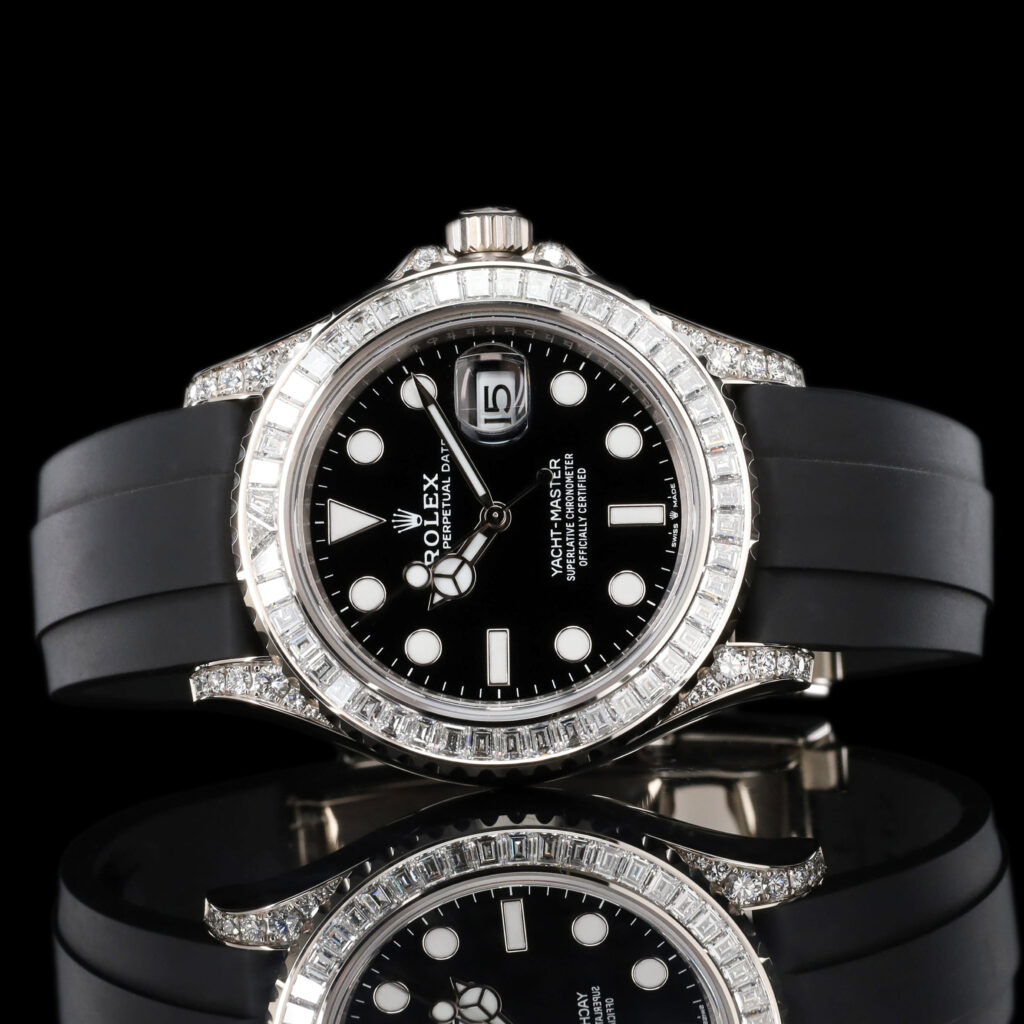
#8 Who Should Actually Buy the Rolex Yacht Watch?
Here’s my honest take.
You should buy this watch if you like a bold design. If you enjoy being a little different. If you don’t want the same Rolex everyone else has.
You should also buy it if you appreciate engineering. That bezel system is wild. The movement is impressive. It’s a nerd’s dream in a flashy body.
You probably shouldn’t buy it if you want something subtle. Or if you hate attention. Or if you’re hoping to flip it fast for profit.
The Rolex yacht watch is for people who choose with their gut, not just their wallet.
I’ve met buyers who waited years before pulling the trigger. When they finally did, they smiled like kids. That tells you something.
If you’re still unsure, compare it to other bold Rolex models.
Sometimes, the right watch just feels right.
Pros:
-
Unique mechanical memory countdown.
-
Unrivaled “wrist presence” and bold 44mm aesthetics.
-
Highly technical Ring Command Bezel.
Cons:
-
Too large for wrists under 6.5 inches.
-
Higher service costs due to movement complexity.
-
Polarizing “YACHT-MASTER II” branding on the bezel.
Conclusion
After all these years, the questions never really change. People still ask why it’s so big, so complex, and so different. And every time, I come back to the same idea. The Rolex yacht watch isn’t trying to please everyone. It never was.
It’s built for people who like presence, who enjoy smart mechanics, and who aren’t scared to stand out. It’s not the safest Rolex choice. It’s not the quietest either. But it might be the most fun.
If you’re drawn to it, don’t overthink it. Try it on. Wear it. Feel it. If it clicks, you’ll know. And if it doesn’t, that’s fine too.
Watches are personal. The Rolex yacht watch just happens to be very loud about its personality.
If you want the Yacht-Master II—the 44mm beast with the Ring Command bezel—you have two choices. You can keep refreshing forums hoping for a “deal” that ends up being a franken-watch, or you can go to thewatchconnect.com/.
We source the authenticated, high-investment pieces you actually want, without the waitlist games. No fluff. Just the watch on your wrist.
More Frequently Asked Questions About the Rolex Yacht Watch
Is the Rolex Yacht Watch waterproof enough for swimming?
Yes. It’s water resistant to 100 meters, which is fine for swimming, showers, and surface water use. It’s not meant for deep diving, but it handles everyday water easily.
Can you wear the Rolex Yacht Watch with a suit?
You can, but it’s tight. The case is thick and wide, so it may not slide under slim cuffs. With relaxed or custom tailoring, it works better.
Is the Yacht-Master II heavier than other Rolex models?
Yes, especially in gold or two-tone versions. The weight is part of the feel. Some people love it, others don’t.
Do you need to know how to sail to use the watch?
Not at all. Most owners never touch the regatta function. They buy it for the design, size, and mechanical complexity.
Is the Rolex Yacht Watch good for small wrists?
Usually not ideal. At 44mm, it wears large. If your wrist is under about 6.5 inches, it may feel overwhelming.
How often does the Yacht-Master II need service?
Rolex recommends about every 10 years, depending on use. Because the movement is complex, service costs are higher than simpler models.