Let’s settle this the way most buyers actually think about it. If you’ve been weighing the Rolex GMT-Master II vs Sky-Dweller, you’re in crowded company. Pilots, business travelers, and regular watch fans keep circling the same question: which one really earns the wrist time? On paper, both track multiple time zones and carry the Rolex name. In real life, they feel very different.
Here’s what tends to surprise people. These watches weren’t built for the same kind of traveler. One is quick, practical, and almost tool-like in daily use. The other leans more toward mechanical sophistication and quiet luxury. The differences don’t always show up in spec sheets. They show up when you actually live with the watch. That’s what we’ll focus on here.
Core Purpose and Design Philosophy
Start with intent. Rolex didn’t accidentally create two travel watches that overlap. Each one solves a different problem.
The GMT-Master II has roots that go back to mid-century aviation. It was designed for pilots who needed fast clarity, not a complicated learning curve. The rotating 24 hour bezel does most of the heavy lifting. In practice, you glance down, and you know what time it is back home. No fuss. No mental math.
The Sky-Dweller arrived decades later with a different audience in mind. Rolex aimed it squarely at business travelers who wanted more information on the dial. Not just another time zone, but also a full annual calendar. It’s mechanically impressive. Maybe even overbuilt for casual use. Still, for the right owner, it makes perfect sense.
Case Size, Wrist Presence, and Everyday Comfort
This is where the two watches begin to separate quickly once they’re on the wrist.
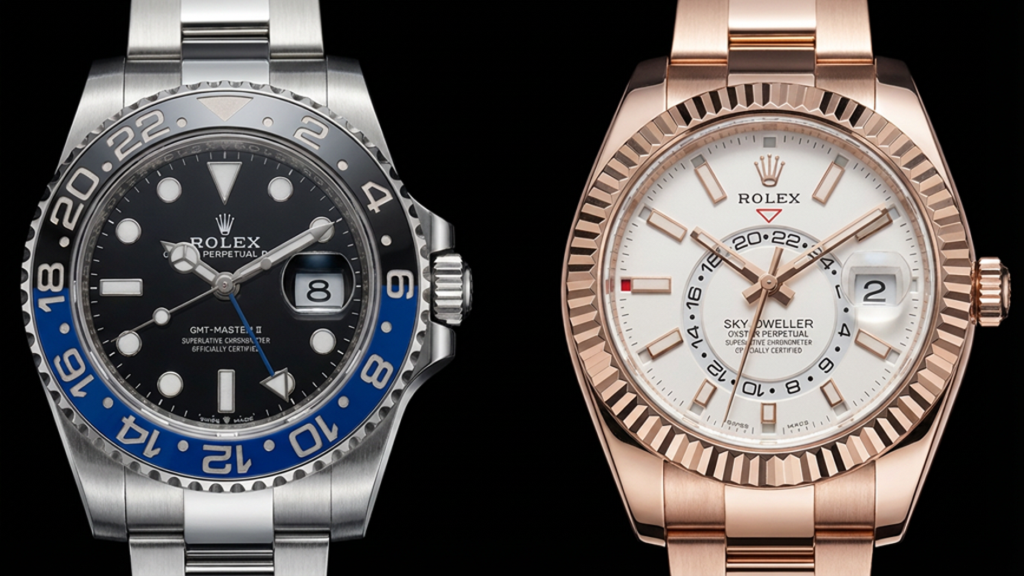
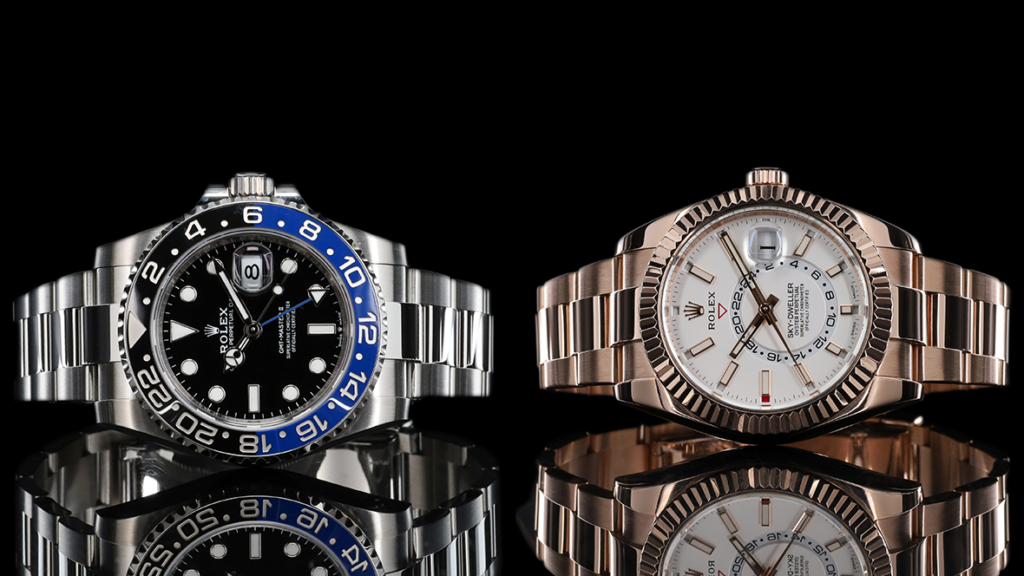
The GMT-Master II sits at around 40 mm. Most people find it balanced and easy to wear for long stretches. It slides under a shirt cuff without much drama. From experience, this is one reason collectors keep coming back to it. You can wear it all day and almost forget it’s there.
The Sky-Dweller doesn’t try to disappear. At 42 mm with more thickness, it has noticeable presence. Some buyers love that immediately. Others realize after a few weeks that it’s more watch than they expected. Wrist size plays a big role here.
Bracelet choice matters too. The GMT-Master II often appears on Oyster or Jubilee, both proven and comfortable. The Sky-Dweller typically comes on Oyster or Oysterflex. Oysterflex helps with wearability, but the case still feels larger overall. That’s just the reality.
Dual Time Function: Practical Use While Traveling
This is the heart of the Rolex GMT-Master II vs Sky-Dweller comparison. How do they behave when you’re actually crossing time zones?
The GMT-Master II uses the classic formula: a dedicated GMT hand paired with the rotating bezel. It’s fast to adjust and hard to mess up. You can jump the local hour hand independently, which makes airport changes painless. Frequent flyers tend to appreciate this more than they expect.
The Sky-Dweller takes a more layered approach. Home time sits on an off center 24 hour disc, while the main hands track local time. Once you understand the layout, it works well. But the learning curve is real. The Ring Command bezel controls several functions, and most new owners need a little time before it feels natural.
If your travel style is fast and frequent, the GMT-Master II usually feels more intuitive. If you prefer having more data on the dial and don’t mind the setup, the Sky-Dweller brings extra depth.
For a deeper technical look at GMT complications, see this resource.
GMT Watch Complication Explained
Annual Calendar and Complications: Where the Sky-Dweller Pulls Ahead
Here’s the area where the Sky-Dweller clearly separates itself. It includes Rolex’s Saros annual calendar system. The GMT-Master II keeps things simple with a standard date only.
In real-world use, the Sky-Dweller automatically adjusts for 30 and 31 day months. You typically correct it once per year in March. For people who track schedules closely, this feature becomes more useful over time than many expect. Clinics and collectors often notice that owners grow to rely on it.
That said, added complexity always brings tradeoffs. Service costs tend to be higher. Operation is less straightforward. Some buyers enjoy that mechanical depth. Others decide pretty quickly they prefer the GMT’s simplicity.
Neither reaction is wrong. It comes down to personality and how much interaction you want with the watch.
Style and Versatility: Sporty vs Executive Appeal
Aesthetics matter more than buyers like to admit. And here the personalities split again.
The GMT-Master II leans sporty without trying too hard. The ceramic bezel options, especially Pepsi and Batman, give it instant identity. It pairs easily with casual clothes and still works in business casual settings. Many owners treat it as their default daily piece.
The Sky-Dweller sits on the dressier side of the spectrum. The fluted bezel and larger case push it toward executive territory. In formal settings, it looks completely at home. Some precious metal versions clearly target buyers who want a stronger luxury signal.
In practice, most people find the GMT-Master II more flexible across different environments. The Sky-Dweller shines brightest when the setting is more polished.
Movement Performance and Technical Differences
Under the caseback, both watches deliver what you’d expect from modern Rolex engineering. Still, their priorities differ.
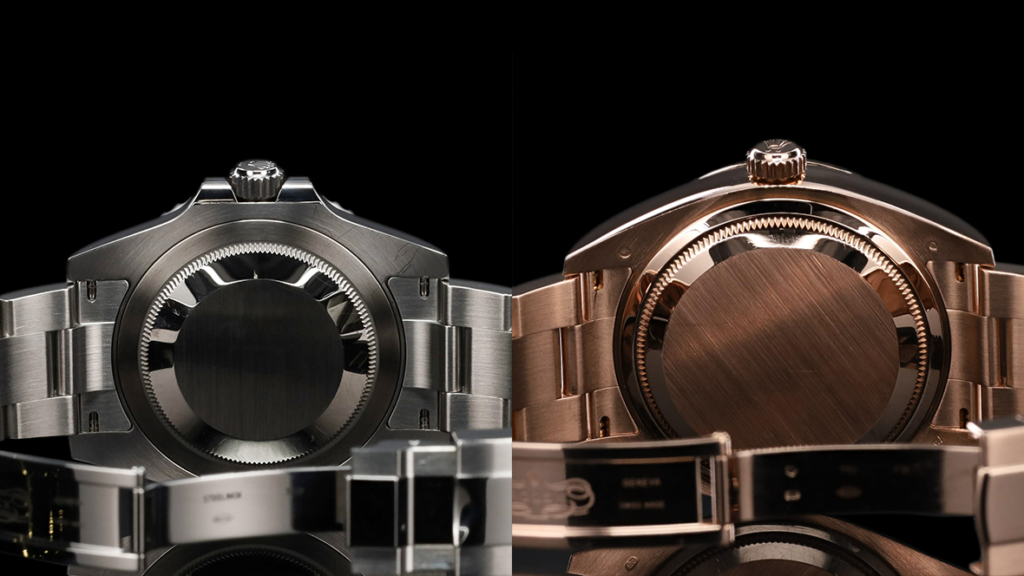
The GMT-Master II runs on the Caliber 3285. It offers roughly 70 hours of power reserve and has built a strong reputation for reliability. The movement is designed for frequent time adjustments without drama. From experience, this is exactly what frequent travelers need.
The Sky-Dweller uses the Caliber 9001, which is significantly more complex. It powers the dual time display and the annual calendar. The added mechanical architecture partly explains the thicker case profile. It’s an impressive piece of engineering, no question.
Independent testing continues to show modern Rolex movements perform at very high accuracy levels. Mechanical Watch Accuracy Standards
In day to day ownership, both movements are extremely dependable. The real difference is how much complexity you want sitting on your wrist.
Price, Availability, and Long Term Value
Eventually, every comparison circles back to cost. And the gap here can shift depending on the market.
Generally speaking, the GMT-Master II starts at a lower retail price than the Sky-Dweller. Steel GMT models remain notoriously hard to obtain through authorized dealers. Secondary prices often climb well above retail, especially for popular bezel combinations.
The Sky-Dweller usually carries a higher entry price, particularly in precious metals. Availability can sometimes be slightly less competitive than hot GMT references, though steel versions are still very much in demand.
Historical market data suggests Rolex sports models tend to hold value strongly over time.
Luxury Watch Resale Market Trends
Still, buying purely for investment rarely works out the way people expect. Most long term owners stay happiest when they choose based on wearability first.
Which Watch Fits Your Travel Lifestyle?
At this point, the decision usually becomes clearer. The Rolex GMT-Master II vs Sky-Dweller question isn’t really about which watch is better overall. It’s about which one fits your routine.
If your travel involves frequent time zone jumps, the GMT-Master II tends to feel more natural. The lighter case, quick adjustments, and sporty profile make daily wear easy. Many frequent flyers settle here and never look back.
The Sky-Dweller makes more sense for travelers who want additional calendar functionality and stronger wrist presence. Business travelers who track dates closely often appreciate what it offers. You just have to be comfortable with the larger footprint.
Most people don’t realize this until they try both. Wrist feel changes opinions fast.
Real World Travel Scenarios: Where Differences Show Up
Spec sheets are tidy. Real travel isn’t.
Flights get delayed. Connections tighten. You’re adjusting your watch half awake while boarding is already underway. That’s where small usability details start to matter more than expected.
With the GMT-Master II, shifting time zones is quick and almost automatic after a while. Unscrew the crown, jump the hour hand, done. The movement keeps running in the background. Frequent travelers often describe this as the watch’s biggest strength.
The Sky-Dweller handles the job differently. Once properly set, it displays a lot of useful information at once. Home time, local time, and calendar all working together. But if you only travel internationally once or twice a year, the added complexity can feel like more than you need.
Pick the GMT-Master II if you:
Travel frequently across time zones
Prefer a lighter, more wearable case
Want fast and intuitive time adjustment
Like sporty aesthetics
Plan to wear the watch daily
Choose the Sky-Dweller if you:
Want an annual calendar complication
Prefer a bold luxury presence
Appreciate mechanical complexity
Travel for business and track dates often
Don’t mind a larger case size
There isn’t a wrong choice here. Rolex designed both watches extremely well. The better watch is simply the one that fits your routine.
Your travel frequency honestly matters more than the spec comparison.
Legibility and Daily Readability
This is one of those areas buyers underestimate until they live with the watch.
The GMT-Master II is extremely easy to read. The Mercedes hands, strong lume, and bold bezel markings do exactly what they’re supposed to do. Even in dim lighting, the Chromalight display holds up well. There’s a reason many collectors call it one of Rolex’s most legible sports watches.
The Sky-Dweller remains readable, but the dial is busier. You have the off center disc, date window, and month markers sharing space. Rolex kept it cleaner than most complex watches, but your eyes do more work here.
If you prefer quick, instinctive time checks, the GMT-Master II usually has the edge. If you enjoy a dial with more going on, the Sky-Dweller delivers that layered feel.
Durability and Long Term Wear
Both watches are built to Rolex’s usual standards, but they wear differently over time.
The GMT-Master II behaves like a true travel tool. The ceramic bezel is highly scratch resistant, and the slimmer profile helps it avoid everyday bumps. Many owners report that it disappears on the wrist during long days.
The Sky-Dweller feels more substantial from the start. It’s still tough, but you’re more aware of it. Some buyers prefer that solid luxury weight. Others eventually decide they want something lighter for daily wear.
This is one area where trying both in person makes a huge difference.
Ownership Experience and Learning Curve
This part often gets overlooked during the buying phase.
The GMT-Master II is straightforward. Most owners figure out the functions quickly and rarely need to revisit the manual. That ease of use is a big part of its long term appeal.
The Sky-Dweller requires a bit more patience early on. The Ring Command bezel system is clever but not immediately obvious. New owners usually spend some time learning the sequence. After that, it becomes second nature for most people. Still, the initial learning curve catches some buyers off guard.
Collectors who enjoy mechanical depth tend to love this. Others prefer the GMT’s simplicity.
| Feature | GMT-Master II | Sky-Dweller |
| Case Size | 40 mm | 42 mm |
| Dual Time Function | Rotating bezel, easy adjust | Ring Command, annual calendar |
| Calendar | Date only | Annual calendar |
| Style | Sporty and versatile | Elegant and luxurious |
| Movement | Caliber 3285 (70 hr power reserve) | Caliber 9001 (complex complications) |
| Price Range | $$$ Lower cost | $$$$ Higher cost |
Final Buying Advice Before You Decide
If you’re stuck choosing, stop staring at the spec sheet for a minute. Think about how you actually live with a watch day to day. That usually tells the truth faster than any comparison chart.
People who care most about comfort and low hassle tend to drift toward the GMT-Master II. It’s the kind of watch you put on in the morning and don’t think about again. Over time, that ease matters more than most buyers expect. Especially if you travel often or just prefer gear that stays out of your way.
The Sky-Dweller pulls in a different crowd. Buyers who enjoy mechanical depth and a more noticeable wrist presence usually warm up to it the longer they own it. There’s more to interact with, more to appreciate. The tradeoff is obvious, though. It asks a bit more attention from you.
If you can, try them on in person. Not quickly. Give each one a few minutes on the wrist. From what I’ve seen, that moment settles the debate for most people.
So, where does the Rolex GMT-Master II vs Sky-Dweller conversation land? It really comes down to priorities. For pure practicality and easy daily wear, the GMT-Master II still has the edge. If your taste leans toward mechanical complexity and a stronger executive feel, the Sky-Dweller makes a compelling case. Neither is the wrong move. They just speak to different kinds of owners.
FAQS:
Rolex GMT-Master II vs Sky-Dweller: Your Questions, Answered Honestly
You have questions. Some of them you’re a little embarrassed to ask. That’s okay. Here are the real answers, no attempt to make you feel bad about your wrist.
What is the actual difference between the Rolex GMT-Master II and the Sky-Dweller?
The GMT-Master II tracks two time zones using a rotating bezel and a dedicated GMT hand. It was built for pilots in the 1950s and still feels like a tool – which, depending on your personality, is either a feature or a limitation.
The Sky-Dweller does two time zones and includes an annual calendar – meaning it automatically accounts for months with 30 or 31 days, requiring only one manual correction per year. It’s a much more mechanically complex watch. It’s also larger, heavier, and more expensive.
Short version: GMT-Master II is the practical one. Sky-Dweller is the impressive one. Neither is wrong.
Is the Sky-Dweller worth the higher price over the GMT-Master II?
That depends entirely on what you value. If you travel frequently, cross time zones constantly, and want something that disappears under your shirt cuff – the GMT-Master II is probably worth more to you on a daily basis, even if it costs less on paper.
If you appreciate mechanical depth, want the annual calendar working for you, and like a watch that makes a statement at a business dinner – the Sky-Dweller earns its premium. Both watches hold their value well. Buy the one you’ll actually wear.
Which Rolex is better for frequent travelers — the GMT or the Sky-Dweller?
The GMT-Master II. It’s not close. You can adjust the local hour hand independently without stopping the movement — meaning you land in Tokyo, pop the crown, click the hour hand forward, and you’re done. Thirty seconds, maybe. The whole operation can be done slightly groggy while the seatbelt sign is still on.
The Sky-Dweller is excellent once set, but setting it involves the Ring Command bezel system, which has a learning curve. For someone crossing multiple time zones every week, that friction adds up.
How hard is the Sky-Dweller to set and operate?
More complex than most people expect the first time, less complex than they fear after a week. The Ring Command bezel controls multiple functions by rotating to different positions before engaging the crown. It’s clever engineering. It is also not intuitive in the way a toaster is intuitive.
Most owners report that after a couple of weeks it becomes second nature. One honest note: if you wear the watch infrequently, you may find yourself re-learning the setting procedure every few months.
What size wrist do I need for the Sky-Dweller vs the GMT-Master II?
The GMT-Master II runs at 40mm and works on a wide range of wrist sizes. It’s been the sweet spot for decades for a reason.
The Sky-Dweller is 42mm with more case thickness. On a smaller wrist — under about 6.5 inches — it can feel like the watch is wearing you. On a larger wrist it looks exactly right. Try both in person if you can. Photographs lie about case depth in a way that is almost criminal.
Which watch holds its value better — the GMT-Master II or Sky-Dweller?
Both hold value extremely well. Steel GMT-Master II models, particularly the Pepsi and Batman bezel variants, have historically traded well above retail on the secondary market due to near-impossible authorized dealer availability. The Sky-Dweller also commands strong prices, though its secondary market is somewhat less fevered than the most sought-after GMT references.
That said: buying any watch purely as an investment is a good way to end up disappointed. Buy what you’ll wear. If it holds value — great. If it brings you joy while depreciating slightly — also great. That’s more or less what joy is for.
Can I wear a Sky-Dweller or GMT-Master II with a suit?
Yes, both. The GMT-Master II has a sporty personality it never quite sheds — under a suit jacket it looks good, deliberately casual in an interesting way. The Sky-Dweller’s larger case and fluted bezel options lean more executive by nature and look completely at home under a French cuff. In business casual or creative professional settings, the GMT-Master II is probably more versatile day to day.
What movement does each watch use, and does it matter?
The GMT-Master II runs Rolex Caliber 3285 — about 70 hours of power reserve, extremely reliable, designed for frequent time adjustments. The Sky-Dweller uses Caliber 9001, which is considerably more complex and powers both the dual-time display and the annual calendar. It’s a big part of why the case is thicker.
For daily accuracy, both are excellent. The practical difference shows up at service time — the 9001 will cost more to maintain. Both should be serviced every five to seven years regardless.
I only travel internationally once or twice a year. Does a GMT complication even make sense for me?
Honestly? The GMT function probably won’t change your life on an annual basis. But you’re not really buying a GMT-Master II for its GMT function any more than you’re buying a sports car for its top speed. The complication is part of the package, and it’s genuinely useful when you need it. A fantastic daily watch that happens to have a useful feature a few times a year isn’t a bad deal.
Which should I buy – the GMT-Master II or the Sky-Dweller?
The GMT-Master II if: you travel frequently, prefer a lighter everyday watch, want something intuitive from day one, and like the idea of a tool watch that happens to be beautiful.
The Sky-Dweller if: you want to own something mechanically extraordinary, enjoy a bolder wrist presence, track dates closely, and don’t mind spending a little time getting to know your watch before it feels natural.
Neither is the wrong answer. The best advice anyone can give you is to try them on in person and trust what you feel in the first thirty seconds. That reaction is usually telling the truth.
Still deciding? We’ve had both the GMT-Master II and Sky-Dweller come through our inventory — and we’re happy to talk through which one makes sense for your wrist, your travel schedule, and your budget. No pressure, no pitch. Just a straight conversation with someone who knows these watches.